 News
NewsAsia at the 2026 World Cup: two wins over Europe, and a gap that keeps closing
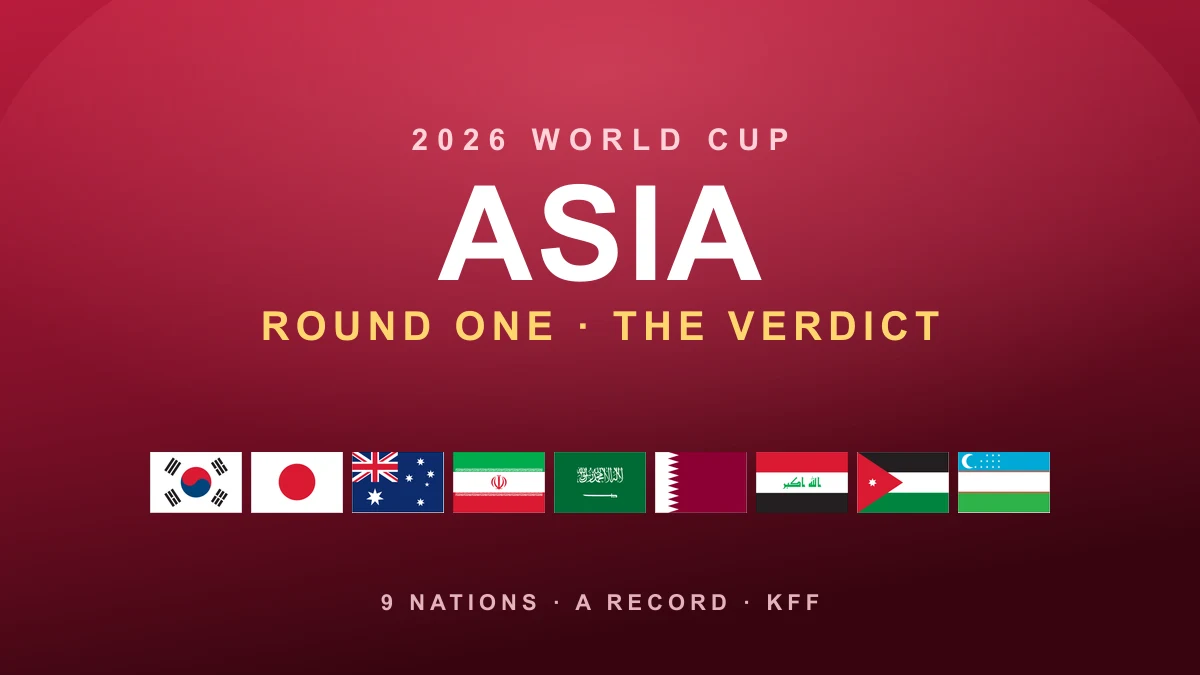
A record nine Asian teams, all drawn against Europe or South America. South Korea and Australia beat European sides, Japan held the Netherlands, and three debutants and returners scored. KFF sizes up Asia's round one.
Asia sent nine teams to the 2026 World Cup, its biggest delegation yet, and the draw gave each of them a hard first test. No two Asian sides shared a group, so all nine opened against a European or South American opponent. Among them were two debutants, Jordan and Uzbekistan, and Iraq returning after 40 years away. Round one did not bring a flood of wins, but it brought something Asian football has been working towards for years: a continent that can live with the best.
The wins came against Europe
Asia's two victories both landed on European opposition, which is the part the bare table hides. South Korea came from behind to beat Czechia 2-1, Hwang In-beom and Oh Hyeon-gyu turning the game around after they had fallen behind. Australia were even more convincing, beating Turkey 2-0 behind a breakout night from teenager Nestory Irankunda, who plays his club football in Germany and looked at home on the biggest stage. Two Asian sides, two beaten European teams, on day one.
They held the giants too
The draws told a similar story. Japan produced the match of the round, twice coming from behind to draw 2-2 with the Netherlands, Daichi Kamada heading a late equaliser against one of the world's best teams. Saudi Arabia led two-time world champions Uruguay before being pegged back to 1-1, Abdulelah Al-Amri with the goal. Qatar snatched a 1-1 against Switzerland through Boualem Khoukhi in the 94th minute, their first World Cup point. Iran came from behind twice to draw 2-2 with New Zealand, the one result of the round they will feel they should have won.
The debutants left their mark
Even the defeats carried moments to keep. Jordan lost 3-1 to Austria on their World Cup debut, but Ali Olwan scored the nation's first goal at a finals. Uzbekistan went down 3-1 to Colombia, with Abbosbek Fayzullayev scoring their first ever World Cup goal. Iraq, back at the tournament for the first time since 1986, were beaten 4-1 by Erling Haaland's Norway and still found the net, Aymen Hussein with the goal. Three nations new or returning to this stage, three of them on the scoresheet.
The numbers, in context
The cold maths reads two wins, four draws and three defeats, with 13 goals scored and 17 conceded, a goal difference of minus four. Put that beside Europe's plus fifteen, South America's plus one, CONCACAF's minus three and Africa's minus nine, and Asia sits in the lower half. The goal difference hides the context that matters most, though. Every Asian team faced Europe or South America, none had the comfort of a game against a fellow Asian side, and both of the wins came against European opposition. Six of the nine finished round one unbeaten.
For the mathematicians: Asia won 22.2% of its round-one games, drew 44.4% and lost 33.3%.
That is two wins, four draws and three defeats from nine teams (two-ninths, four-ninths and three-ninths, if you want it exact).
So how good was it?
Good, with room to grow. The competitive displays were real, and so were the soft spots. Iran should have beaten New Zealand. Saudi Arabia let a lead slip against Uruguay. Japan looked open at the back in a way their disciplined 2022 side rarely did. None of that is fatal in a 48-team format where finishing third can still be enough to go through, but it is the difference between competing and progressing.
The view from Kenya
Asian football flies a little under the radar in Kenya, where weekends belong to the Premier League and the Saudi Pro League now pulls a crowd of its own. The faces are not all strangers, though. Son Heung-min made his name in north London, the Saudi league is where some of the planet's biggest names now play, and an underdog story always travels. Mtu akijaribu, anaheshimika, when someone gives it a real go, they earn respect. Asia gave it a real go.
What round two asks
The platform is there. Matchday two will show whether Asia can turn competitive into decisive. Can South Korea and Australia back up their wins? Does Japan tighten things at the back? Can Iran finally see off a side they should beat, and can the debutants and returners claim a first point? One line frames the whole campaign. No Asian side has gone beyond the last 16 since South Korea reached the semi-finals on home soil in 2002. On the evidence of round one, this might be the year that record gets a real test.
Your team needs you. Have your say.
Vote for your team