 News
NewsEurope at the 2026 World Cup: the goals flowed, but the giants got a fright
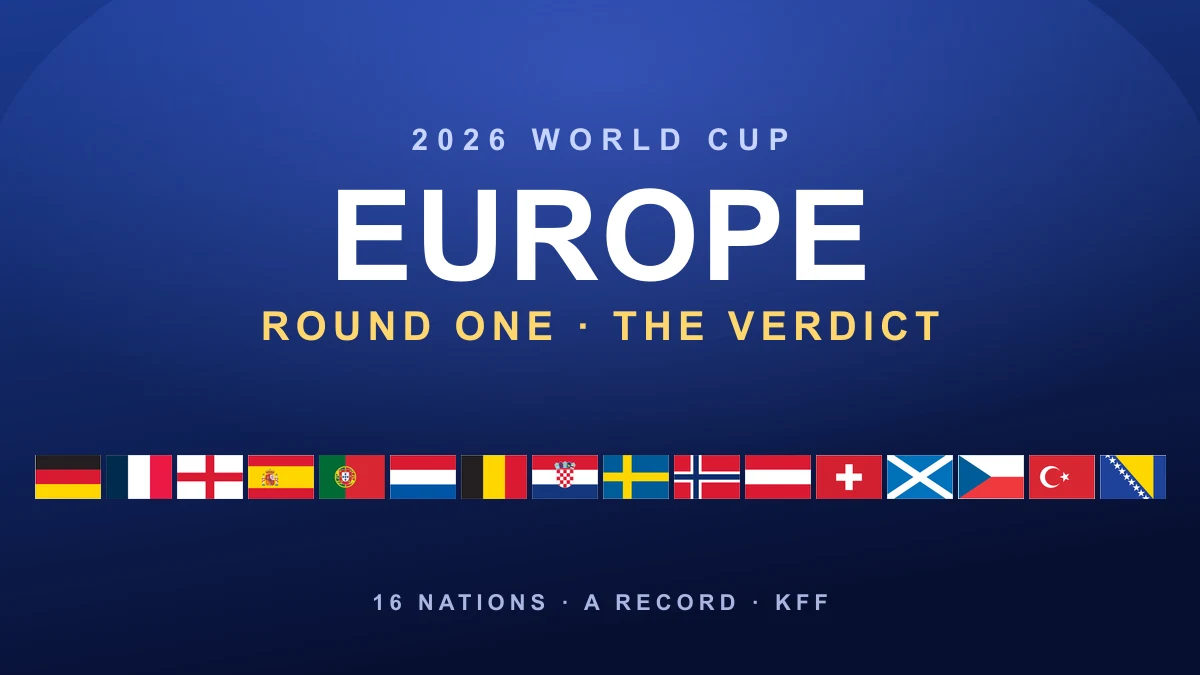
A record 16 European teams, 36 goals and seven wins in round one, led by Germany's 7-1. But Spain, Portugal, Belgium and the Netherlands all dropped points, and two more lost. KFF sizes up Europe's opening round.
Europe brought 16 teams to the 2026 World Cup, more than any other continent and the biggest European turnout the tournament has seen. Round one mostly went to script. The continent scored freely, took seven wins from its sixteen openers, and put four of its forwards straight onto the Golden Boot board. It was not all comfortable, though. Several of the biggest names came through the round with a fright and a few hard questions to answer.
The big guns delivered
When Europe's heavyweights attacked, almost nobody lived with them. Germany ran up the result of the round, thrashing debutants Curaçao 7-1 with Kai Havertz scoring twice. Sweden put five past Tunisia, the goals shared between Alexander Isak, Viktor Gyökeres, Yasin Ayari and Mattias Svanberg. Norway marked Erling Haaland's first World Cup with a 4-1 win over Iraq, the striker helping himself to a brace. France beat Senegal 3-1 without ever moving out of second gear, Kylian Mbappé leading the line. England then served up the round's best watch, a 4-2 win over 2022 semi-finalists Croatia in which Harry Kane scored twice.
The Golden Boot is a European story
The early scoring charts read like a Premier League team sheet. Haaland, Mbappé, Kane and Ayari all finished round one on the board, and the race for the Golden Boot quickly became a European conversation. This is the deepest group of attackers the continent has sent to a World Cup in years, and most of them are only getting started.
The smaller nations stepped up too
Europe's depth showed below the elite. Scotland beat Haiti 1-0 for their first World Cup win in 36 years, John McGinn settling it. Austria did the same to Jordan, winning 3-1, with Marko Arnautović holding his nerve from the penalty spot deep into stoppage time for a first Austrian World Cup win since 1990. For two nations used to watching tournaments from home, those were big afternoons.
But the giants got a scare
Round one was not kind to everyone at the top. Spain, the European champions, were held 0-0 by debutants Cape Verde and could not find a way through. Portugal drew 1-1 with another newcomer, DR Congo, after Cristiano Ronaldo's side were pegged back. The Netherlands conceded twice in a 2-2 draw with Japan. Belgium needed Romelu Lukaku off the bench to rescue a 1-1 against Egypt, having trailed for most of the night. Two others had it worse: Turkey lost 0-2 to Australia, and Czechia went down 1-2 to South Korea. Six leading European sides dropped points or lost, often to opponents they expected to beat.
The numbers, and the gap
Add it up and Europe finished round one with seven wins, six draws and three defeats. Its teams scored 36 goals and conceded 21, a goal difference of plus fifteen. England's 4-2 over Croatia was the one all-European meeting, so a little of that came at a fellow European's expense. Set the figure beside Africa's round one, where ten teams finished on a goal difference of minus nine, and the distance between the game's old power base and everyone else is still huge. It was not a flawless week for Europe. Even so, no other continent came close to its output. South America was the next best on goal difference, CONCACAF leaned heavily on its three host nations, and two of Europe's sides were still beaten by Asian opponents.
For the mathematicians: Europe won 43.75% of its round-one games, drew 37.5% and lost 18.75%.
That is seven wins, six draws and three defeats from sixteen teams.
The view from Kenya
For Kenyan fans, a lot of this felt familiar. The players lighting up Europe's group games are the same ones Kenyans watch every weekend in the Premier League and across the continent: Haaland, Ødegaard, Kane, Isak, Gyökeres, Bellingham. Hawa wasee tunawajua, we know these guys, and watching them carry their countries adds an extra pull to the late EAT kick-offs. The neutral in Nairobi might be backing an African side, but the European games are where most of the familiar faces turn up.
What round two asks
Round one is only a snapshot, and the expanded format gives even the sides who slipped up plenty of room to recover. Matchday two brings the obvious questions. Can Spain and Portugal break down an organised defence when a draw is no longer good enough? Do the Netherlands and Belgium tighten things up at the back? And can Turkey and Czechia rescue campaigns that are already in trouble? Europe still looks like the team to beat at this World Cup. Round one only suggested it will not have everything its own way.
Your team needs you. Have your say.
Vote for your team